Professional Partners

- Axis SLV is a consulting engineering company performing designs of machinery, pressure vessels, structures, vehicles for the following industries:
• Petro-Chemical
• Nuclear
• Defense
• Transport
• Security
• HVAC
• Manufacturing
Axis SLV does work, for mainly the South African industries, but also has experienced working for the armoured and leisure vehicle industries in the USA.
Company Short History
The firm was established in 1991 specializing in the design of special machinery and vehicles. The projects are undertaken then were typically the design of fire engines and special vehicles and special testing facilities for the military. The cc gradually moved from design only, to both design and manufacture.The manufacturing capabilities started in 1994 when the firm was contracted to manufacture anti-riot water cannon vehicles for crowd control during the 1994 elections. Manufacturing and fabrication continued till 2009 when it was decided to scale down the company’s activities to consulting engineering only. By then the company had vast experience of both design and manufacture to serve the
the industry with experience-driven design and planning.
NEW UPCOMING HYDROGEN FROM COAL GASIFICATION PROJECT
“Blue” hydrogen economies could address many of the economic and environmental challenges Africa and the world faces.
Producing and consuming “blue” hydrogen locally would avoid imports of fossil-based fuels and chemicals. This would reduce dependency on a foreign currency and help improve trade balances. The savings from this and from reducing pollution (externalities), as well as socio-economic benefits, could fund new hydrogen programs.
Partnerships between industry, the financial sector, science institutions, the public sector and governments could make these hydrogen economies happen rapidly. Hydrogen technology is ready for use and available now! New markets for it are growing rapidly and offer a great range of environmentally-friendly business opportunities.
For the production of hydrogen from coal, coal gasification is used. The process of coal gasification uses steam and a carefully controlled concentration of gases to break molecular bonds in coal and form a gaseous mix of hydrogen and carbon monoxide. This source of hydrogen is advantageous since its main product is coal-derived gas which can be used for fuel. The gas obtained from coal gasification can later be used to produce electricity more efficiently and allow a better capture of greenhouse gases than the traditional burning of coal.
If you use waste/lower grade coal instead of natural gas, you have income from the waste (instead of paying for the gas). Preferential gasification technology is also able to use natural gas along with waste to form even more hydrogen. Even “brown hydrogen” (from coal) can be turned “blue”. Unluckily, only when reducing the waste input.
The hydrogen now contains all the energy from waste, gas and/or coal. Using this energy, it only emits water in a hydrogen gas engine, a hydrogen gas turbine (CCGT), a hydrogen car/ship/aeroplane. Even before the latter technologies are rolled out, you can already sell the hydrogen as a much-needed commodity chemical.
Hydrogen technology can unlock the large amount of untapped renewable energy in the world. Large scale storage and flexible transmission of renewable energy would achieve green electrification of sub-Saharan Africa, Europe and South East Asia. Using hydrogen as an energy carrier, large scale renewable energy farms as well as mini-grid solutions could become commercially viable.
Hydrogen has a high energy density (compressed at 700 bar) so it is the only environmentally friendly alternative fuel for rail and automotive use. It could fuel vehicles carrying heavy loads and long-haul transport in trucks and buses. It could also power the millions of lightweight utility vehicles that sub-Saharan, Europe and South East Asia societies depend on.
There’s a secondary application of “blue” hydrogen after the power and transport sectors. It serves the chemical industry (such as for making fertilizer), the steel industry (used as a reduction agent) and as a reliable fuel for high temperature industrial processes.
Sub-Saharan Africa is an ideal environment for developing the first hydrogen economies from scratch. That’s because the flexibility of hydrogen is highly valued by African authorities. They understand that it is the most versatile energy carrier and could be the crucial missing link in their transition to green energy.
Typical Work Done For Various Industries:
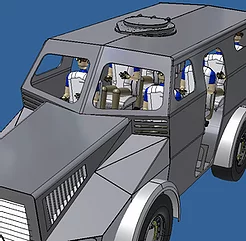
Military Armoured Vehicles
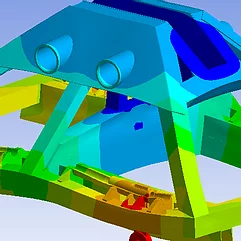
Structural Support for Nuclear Safety
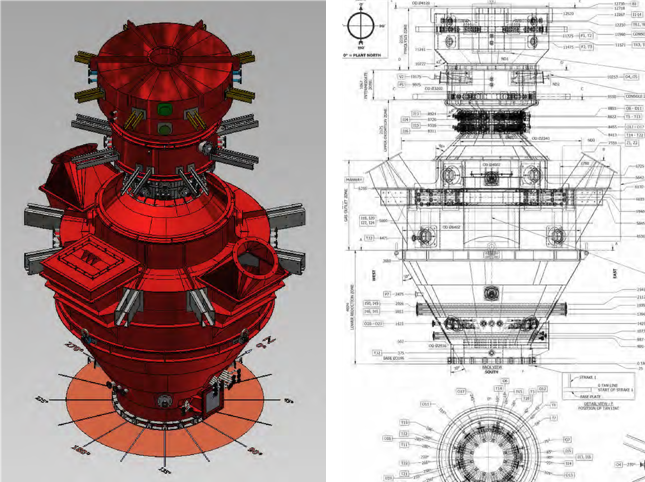
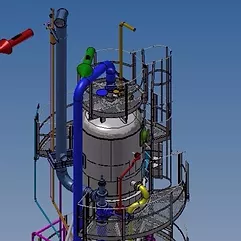
Petro- Chemical Distillation Column
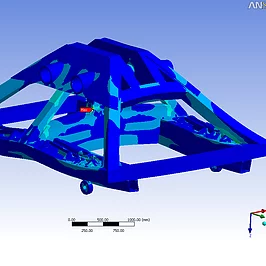
NUCLEAR
From September 2008 till March 2009 work was done for the PBMR [Pebble
Bed Modular Reactor, Company] in Pretoria on structural and component design of nuclear safety-critical components and structures, mainly according to the ASME pressure vessel codes. Designs were verified and optimized making use of finite element analyses (FEA) methods.
• A lifting frame with a capacity of lifting a 200-ton load was designed. The
the design was optimized with ANSYS finite element analysis (FEA) software.
• A support structure for a cooling system required to protect the concrete of the reactor building was designed. These weld assembly designs were also optimized making use of FEA software.
MILITARY INDUSTRY
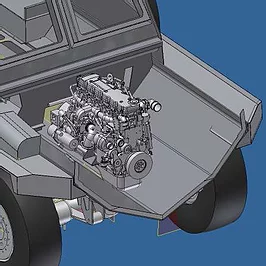
Design of various mine-resistant armored personnel (MRAP) vehicles.
These included the design of the following subsystems:
1. Drive train combinations including dynamic and performance calculation and simulation of vehicles with different combinations of
engines, transmissions, and final drives.
2. Design of suspension sub-systems
3. Design and sizing of the engine, air to the water heat exchanger (radiator)
4. Design and sizing of engine turbocharger intercooler
5. Design and layout of the air conditioning subsystem.
6. Design of vehicle hull structure, with optimization and verification utilizing FEA techniques.
TRANSPORT
• Design and building of Low Mass load bodies for heavy-duty trucks to maximize legal payload on public roads. These load bodies are made of either Aluminium or high strength steel. To minimize the weight, finite element analysis (FEA) had to be implemented to cut away all unnecessary material.
• Design and build of low mass trailers (25-tonne payload) fabricated entirely from aluminum to be used in combination with light-bodied trucks to maximize the legal payload on public roads.
• Design and build of cryogenic testing chambers for an automotive
electronics company to test lead-free soldering crystal growth below
minus 40 ° C., These chambers could operate at below minus 50° C and
made use of 2 refrigeration circuits in tandem using R22 and R23 refrigerants.
• Investigation into the design integrity of a stretched Chrysler 300 limousine, making use of FEA methods.
This was done for a coachbuilding company in Springfield Missouri in the USA. Certification of the stretched Chrysler limousine, of which 20 had been sold to a British customer, was required by the British Automotive authorities. Structural analyses on the suspension components, and the stretched hull, using finite element analysis (FEA) techniques were done to determine safety margins on the vehicle.
• Modelling up the suspension components of the stretched Chrysler Limousine and verify the integrity using FEA methods.
• Design and manufacture of the air conditioning systems for the Transnet
Blue Trains (2 train sets)
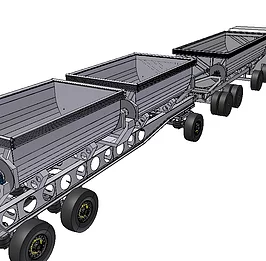
• Design and development of a revolutionary new lightweight heavy haulage NTST trailer system.
HEATING VENTILATION & AIRCONDITIONING
• Low-cost water chilling machines for the bakery industry
Water chillers for train air conditioning
• Shell and tube heat exchangers
• An air conditioning system for 2 luxury tourist train sets including the
compact air handling units for each individual compartment.
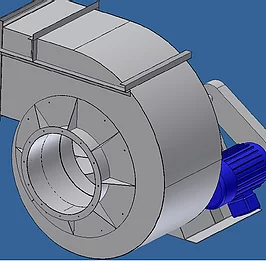
• Centrifugal fans and blowers for ventilation up to 25 cubic meters/sec (size
limited by factory electrical installation capacity limit) These are both single
as well as double inlet centrifugal fans
• Cyclones for particle separation, for the wood industry as well as for coal-fired
power stations.
• Air handling and filtration plants.
• Design of mechanical building services for a new hospital complex
including air-conditioning, heating, special clean air filtration, medical
gasses layouts, morgues, steam heating and reticulation installations, the
steam generation installation and the incinerator facility. (This was done in
capacity as a consulting engineer and applicant was not involved in
manufacturing)
• Design of a wet scrubber plant for a fertilizer manufacturer
GENERAL MACHINERY & STRUCTURES
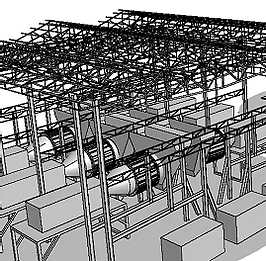
• Various machinery structures and bases for the general industry, minerals processing industry, and mining applications.
• Rotary drying kilns for a fertilizer manufacturing plant.
• Conveyors: various types: Belt conveyors, screw conveyors, shaftless screw conveyors, conveyors and turntables for the food industry,
conveyors for baggage handling systems at airports, conveyors for the automotive part manufacturing industry.
• Various blenders and mixers for general industry
• A vegetable washing machine for the fresh produce packaging industry.
• Low cost re-usable collapsible hydraulic struts for the underground mining industry.
• A debarking and de-branching machine for wood log harvesting, which also could cut the harvested logs to specific lengths. One prototype of this machine was built.
• Drying machines to dry sporting (cricket) fields after rain for quick
resumption of games (for the cricket world cup tournament in South Africa)
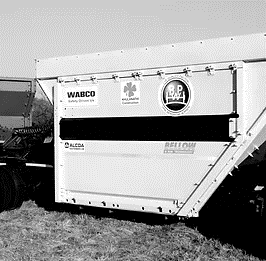
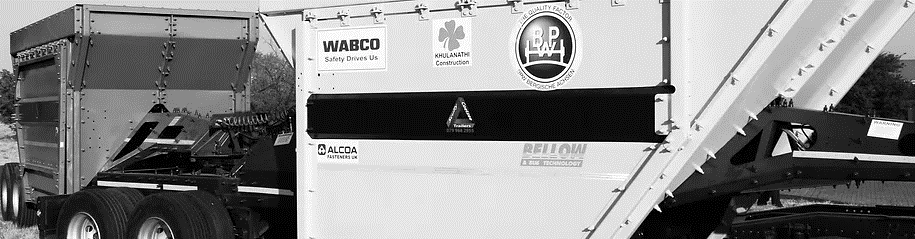
RIVOT TRAILERS
The entire trailer(s) is fabricated from high strength SSAB (Swedish) or
Thyssen Krupp steel.
• No welding is used in the fabrication process.
• The trailers are riveted together.
• The strength of the material is therefore not weakened by any hot operation.
• The fatigue strength of the material is therefore 4-5 times higher than the material in welded structures.
• The design was done to keep the stresses in the parts, below the fatigue level of the material, resulting in unlimited fatigue life.
• The trailers have no dedicated chassis, and the load-bearing is done by the shape of the load boxes.
• Due to the absence of a dedicated chassis, the payload could be 15 %
higher than that obtained from the currently available side tipper trailers.
• Offloading can safely be done whilst being in motion, with no danger of overturning.